
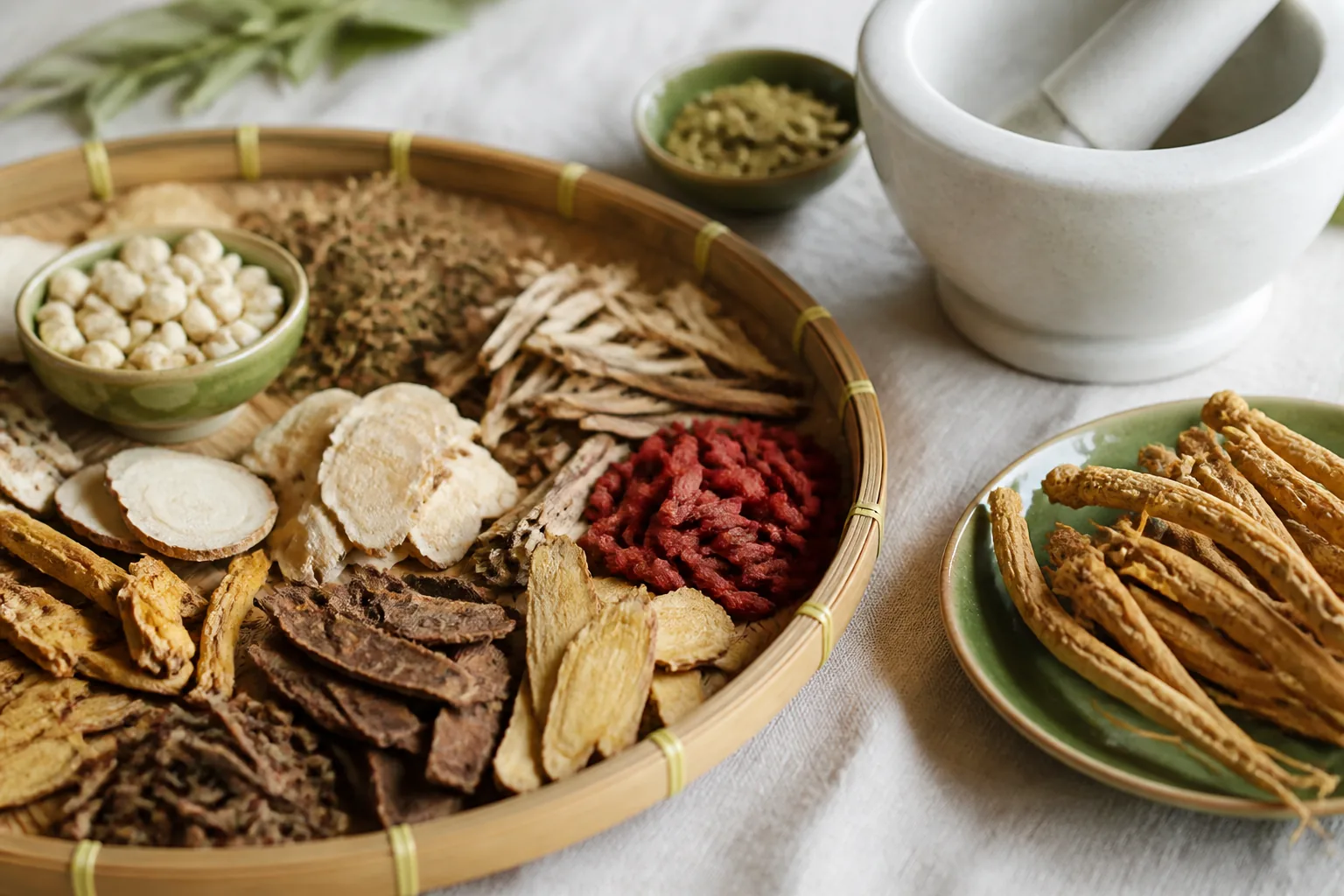
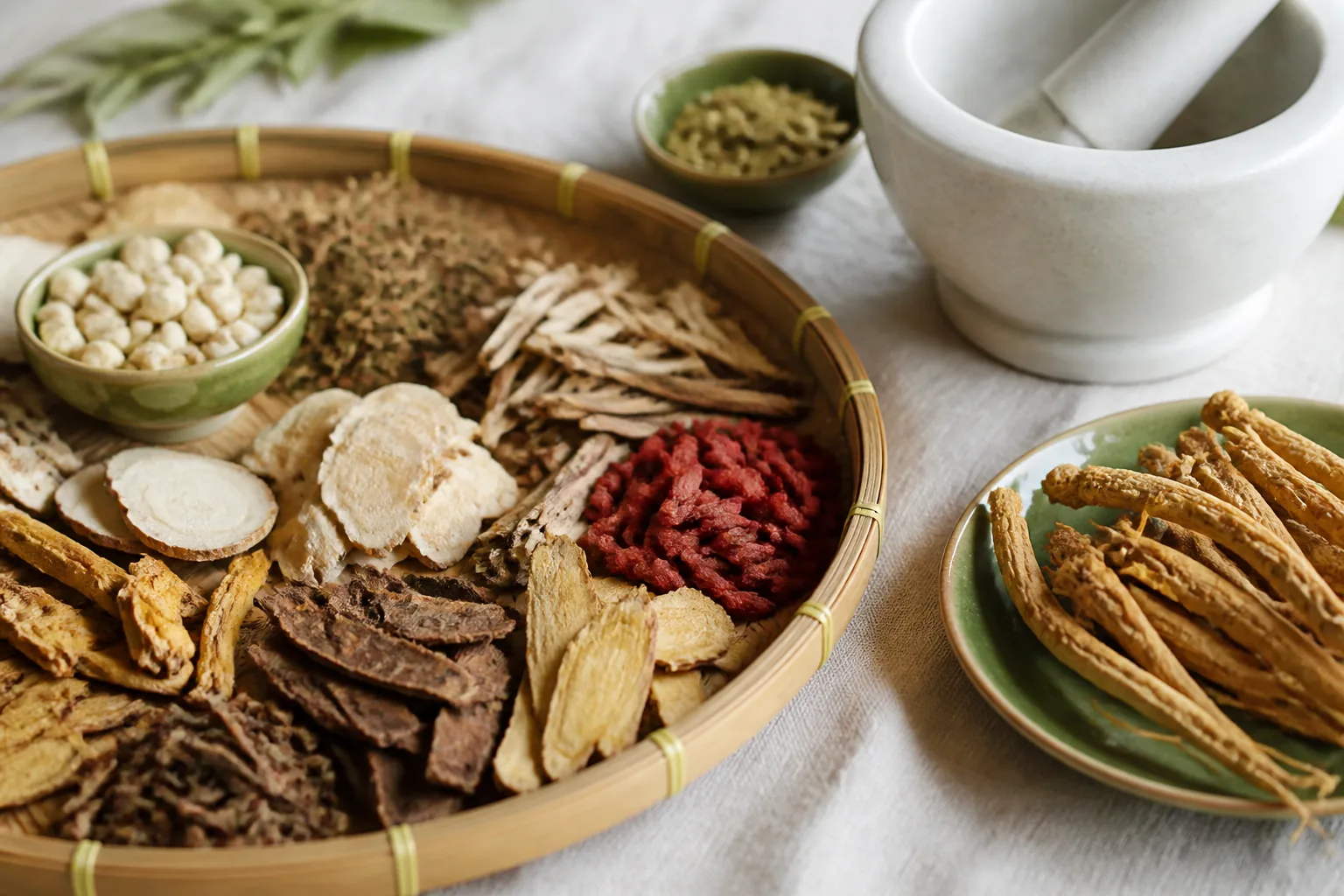
Chinese herbal medicine is the use of single herbs and, far more often, multi-herb formulas within Traditional Chinese Medicine. It is best understood as an individualised therapeutic practice rather than a shelf of wellness supplements, because the herbs are usually selected for a particular person's overall presentation rather than for a condition label alone, and that distinction matters a great deal for anyone weighing it up.
This article covers four things a careful reader needs before a first conversation with a practitioner: how formulas are put together and prescribed, the forms herbs are taken in, what the research can and cannot reasonably suggest, and the safety and interaction questions worth raising with your practitioner, GP or pharmacist. For those who'd like to browse our herbal formulas while reading, the aim here is neither to sell the practice nor to dismiss it, but to help you ask better questions.
How does Chinese herbal medicine work in practice?
Chinese herbal practice draws on a long-established materia medica, the catalogue of plant, mineral and other substances used as medicines. A few of these are given singly, but most are combined into formulas in which different ingredients carry different jobs. As one certified herbalist has described it in Cleveland Clinic's health publication, traditional formulas consist of herbs with strictly designated roles, so that some address the primary complaint while others are included for secondary symptoms, and most formulas are then customised to the individual.
The selection rests on what practitioners call pattern differentiation, which in plain terms means looking at a person's whole head-to-toe collection of signs and symptoms rather than a single isolated complaint. The same herbalist put the difference bluntly: herbalists treat patterns and patients rather than diseases. In practical terms, two people arriving with the same symptom may well leave with different formulas, because their broader presentation, constitution and medical history differ.
This is also why a formula that seems to suit a friend or a family member should not be assumed to suit you. The herbalist quoted gave a simple illustration: peppermint is considered cooling and cinnamon warming, so the herb chosen for someone experiencing hot flushes during menopause may be entirely wrong for someone who feels the cold. Matching the formula to the person is how practitioners aim to avoid unwanted effects.
What forms do Chinese herbs come in, and how are they prescribed?
Herbs are dispensed in several forms, and the choice usually comes down to practicality. Traditional decoctions, where raw herbs are simmered into a strong tea, are the oldest method, while granules, powders, capsules, pills and liquid extracts are more convenient and can make dosing more consistent and the taste more tolerable. Any of these may be prescribed either as a traditional formula or as one the herbalist composes for the individual.
Prescribing is meant to be an ongoing process rather than a single handover. Formulas may be modified as symptoms settle, or changed outright if health status, medications or circumstances shift, which is why the practitioner quoted above said she would not simply repeat a year-long prescription without reassessing the patient. Dose, duration and review all matter, and timeframes vary: she noted that Chinese herbal medicine treatments for something acute may be short, whereas long-standing, complex problems can take considerably longer.
One point deserves emphasis, which is that herbs are not harmless simply because they are natural. The advice from the same practitioner was to treat Chinese herbs as you would a prescription medicine and to get an evaluation from a qualified practitioner before taking anything, rather than self-treating.
Familiar herbs are ingredients, not stand-alone cures
Readers often arrive having heard of a handful of herbs: ginger, liquorice root, astragalus, ginseng, goji berry and peony root among them. These appear widely in Chinese herbal practice, but it is worth resisting the urge to read them as individual remedies with fixed effects, because a herb's role depends on the formula it sits in, the dose, how it has been prepared and the pattern the practitioner has assessed. The same substance can be a principal ingredient in one formula and a minor supporting one in another.
Ginseng is a useful illustration, and not for its reputation. The herbalist quoted earlier noted that although ginseng is popular, it may not be suitable for everyone, since it can overstimulate the central nervous system. That is exactly the kind of consideration a practitioner is weighing when deciding whether a herb belongs in your formula at all.
Combining many herbs also complicates interpretation. A critical review published by a university science office observed that patients in one hospital dataset typically received combinations of 16 to 18 different herbs, which makes it difficult to attribute either a benefit or an adverse reaction to any one ingredient. Transparency about what is in a formula therefore matters as much as the formula itself.
What the evidence suggests, and why broad claims are difficult
Some herbs and formulas have been studied for particular symptoms and conditions, and there is active scientific interest in the chemistry behind them. A large computational study discussed in that review mapped links between symptoms, proteins and herbs and reported associations that were more likely than chance alone, which its authors argued points to a biological rationale for at least part of traditional practice.
The limitations, though, are real and worth understanding. That same analysis was done on computers rather than in clinical trials, and when the authors tested their model against records from nearly 2,000 hospitalised patients, fewer than 10 per cent of herb-symptom pairings showed a statistically significant effect, 86 out of 888. The review also raised a point that applies to herbal medicine generally: herbs contain variable amounts of many chemicals depending on where and when they were grown, so standardising a dose is harder than with a single-molecule drug.
Two cautions follow from that. First, no single study can prove or disprove Traditional Chinese Medicine as a whole, and herbal medicine, acupuncture, cupping and the other practices gathered under that umbrella should not be collapsed into one evidence claim; the computational study, as the review pointed out, examined herbalism only. Second, the useful question is always specific: what evidence exists for this formula, for this indication, in people like me? More clinical research is needed before firm conclusions can be drawn about particular conditions, even though many patients do report improvement after treatment.
Chinese herbal medicine safety: what to ask before you take anything
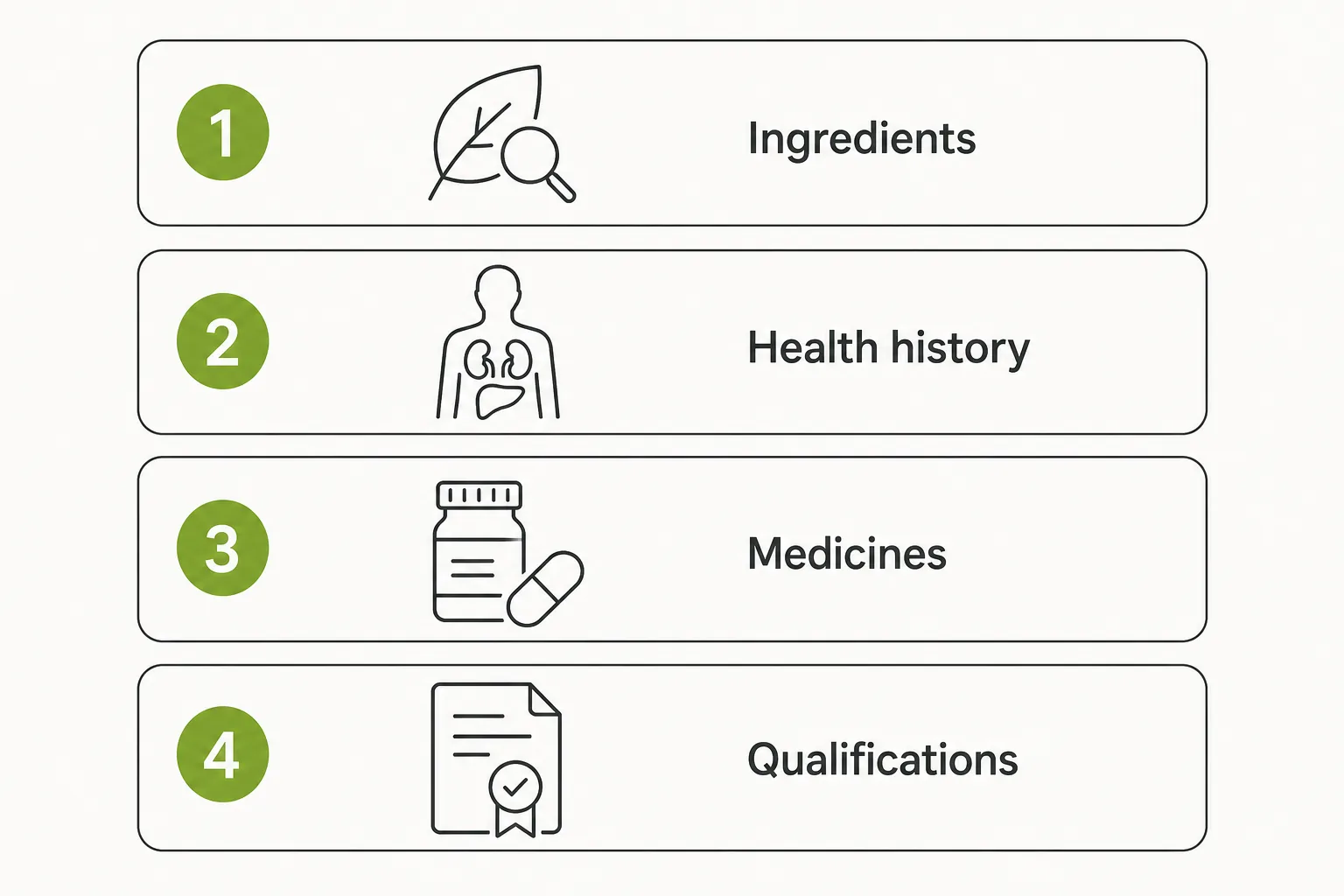
Ask first about what is actually in the formula. Request full ingredient disclosure, including botanical names, and ask where the herbs are sourced and what testing or quality control they undergo, because contamination, adulteration, substitution of one plant for another and variable concentrations of active chemicals are all documented risks. The review mentioned earlier recounts a serious example from the 1990s, where a plant substituted for a listed herb in a weight-loss preparation in Belgium was linked to an outbreak of end-stage kidney failure. Correct identification is not a technicality.
Second, ask how your own circumstances are being assessed. Pregnancy and breastfeeding, known allergies, liver or kidney disease, previous adverse reactions to herbs or medicines, and any change in your current symptoms should all be reviewed before a formula is recommended. Liver and kidney function matter particularly because those organs clear both drugs and herbs from the body, and checking them is described as a standard safety measure, with monitoring continuing during treatment.
Third, bring a complete list of everything you take: prescription medicines, over-the-counter products and supplements. The reason is simple, in that herbs and drugs may not interact well together. If you take medicines where small changes in effect carry real consequences, such as anticoagulants, diabetes medicines, immunosuppressants or sedatives, it is worth having your GP or pharmacist review the proposed formula as well. Ask too what changes you should watch for, what symptoms should prompt you to stop and make contact, and when conventional medical care should take over, since herbs are not a substitute for usual medical care.
Finally, check qualifications. Look for a practitioner who has completed formal training in Chinese herbal medicine and holds the relevant registration; in Australia, Chinese medicine practitioners are registered with the national regulator, so you can confirm this before booking, and many of these same practitioners also offer complementary acupuncture therapy alongside herbal prescriptions. It is also worth asking whether the practitioner is willing to work alongside your doctor. None of this requires you to accept promotional claims or to dismiss the practice outright, because a reasonable middle position is available: seek qualified guidance, insist on transparency about ingredients and quality, keep your doctor informed, and treat any formula with the same seriousness you would give a prescription.
References
What You Should Know About Chinese Herbs